
How AI Changes Emotional Conversations
AI reshapes how Indians express feelings—multilingual, 24/7 empathetic chat that's private but raises privacy and reliance concerns and can't replace therapists.
Mental Health
Dec 16, 2025
AI is reshaping how people in India communicate emotions, especially in a country with 22 official languages and numerous dialects. Expressing feelings can be tough, but AI bridges these gaps by offering multilingual support, emotional analysis, and non-judgmental companionship. Tools like Vibe and others are helping individuals articulate emotions, detect moods, and receive empathetic responses in their preferred language, including Hinglish, Hindi, and English.
Key takeaways:
AI for Emotional Support: AI tools like chatbots provide 24/7 availability, helping users manage loneliness, stress, and anxiety without fear of judgment.
Multilingual Conversations: AI enables seamless language switching, making emotional communication easier for users in Tier 2 and Tier 3 towns.
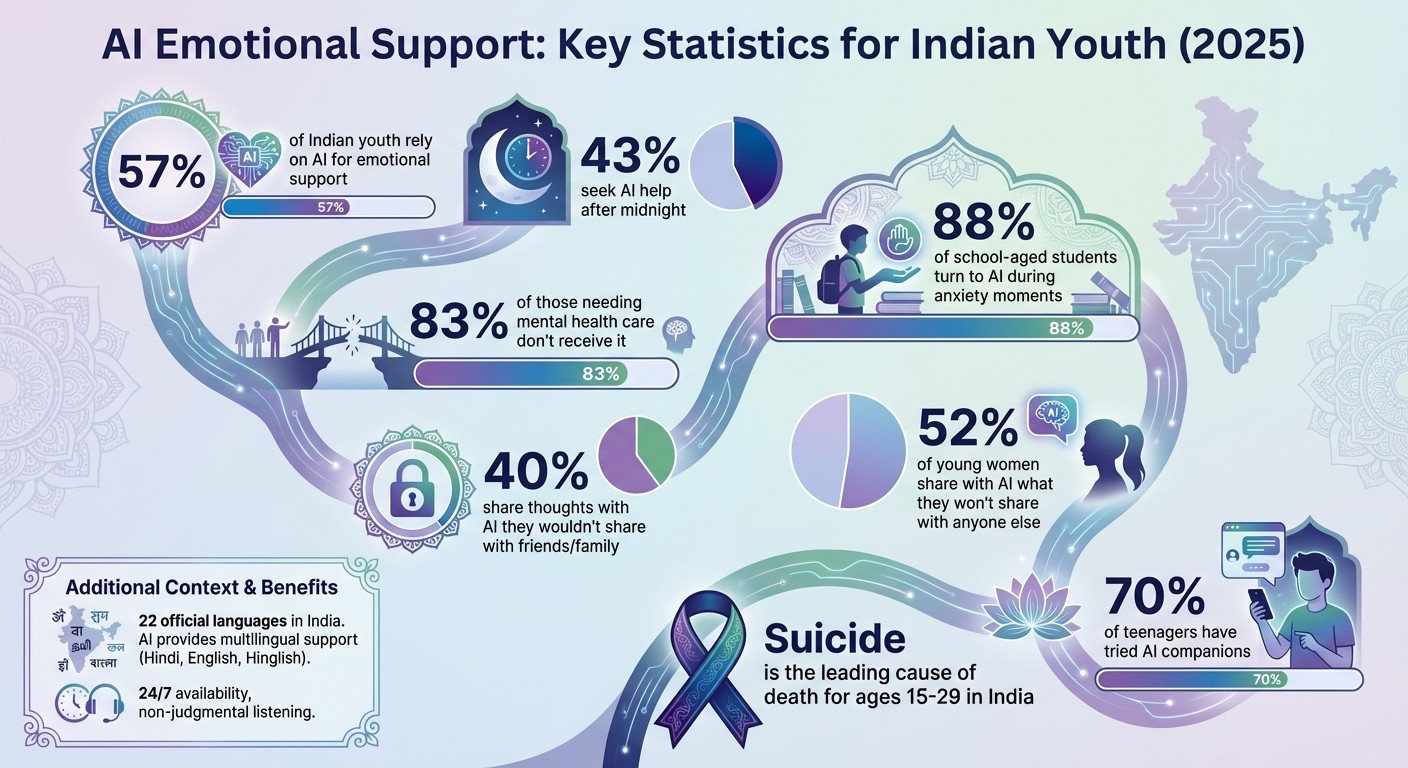
User Statistics: 57% of Indian youth rely on AI for emotional support, with 43% seeking help after midnight.
Privacy Concerns: AI tools may collect sensitive data, raising questions of over-reliance and safety.
Limitations: AI can't replace therapists or handle severe mental health crises but serves as a helpful supplement.
AI is not a substitute for human relationships but acts as a bridge, offering a safe space for self-expression while recognising India’s linguistic and emotional diversity.
AI Emotional Support Statistics for Indian Youth 2025
AI: The New Confidant for Young Indians Navigating Emotional Challenges | AI Use In India | News18
How AI Improves Emotional Clarity
AI is changing the way we understand and express emotions, helping us articulate feelings with greater precision. By analysing words, tone, pauses, pitch, and even non-verbal cues, AI can identify emotions like happiness, frustration, or anxiety. This process makes it easier to understand your emotions, even when you're struggling to put them into words. Here's how AI is making strides in emotional clarity.
Emotional Recognition and Mood Detection
In 2025, Fora Soft's Translinguist platform demonstrated the power of emotional analysis by interpreting facial expressions and voice cues to enhance translation across 62 languages. The platform captures subtle elements like pace, intonation, and pauses, adapting to the user’s emotional state. Whether you're speaking Hindi, English, or a mix of both, this technology ensures more natural and emotionally aware communication.
Personalised and Empathetic Responses
Once AI detects emotions accurately, it can craft responses that feel personal and empathetic. By interpreting emotional signals, AI engages in interactions that seem both natural and supportive. Its objectivity and lack of bias make it a safe space for open self-expression. Over time, AI tailors its responses to your unique communication style and past interactions, creating a sense of familiarity and trust.
Continuous Learning for Better Conversations
AI doesn't just stop at detecting emotions; it learns and evolves. Through ongoing feedback and advanced algorithms, cross-language emotion recognition has improved by 20%. This means AI can predict your emotional needs better and adapt its support accordingly. By tracking emotional patterns over weeks or months, AI identifies recurring issues and refines its responses to offer more meaningful and proactive assistance.
Benefits of AI for Emotional Conversations
AI-powered emotional support is becoming a lifeline for India's Gen Z, addressing critical gaps in mental health care. Nearly 57% of Indian youth now turn to AI tools like chatbots for emotional support, bridging issues like accessibility, cultural nuances, and availability. This shift is especially important in a country where over 83% of those needing mental health care don't receive it, and suicide remains the leading cause of death among those aged 15–29. AI's ability to provide round-the-clock, culturally relevant support is changing the way mental health conversations happen.
24/7 Availability and Non-Judgmental Listening
Human support often falls short - friends have their own lives, and therapists operate on fixed schedules. AI steps in to fill these voids, offering constant, unbiased companionship. By 2025, 43% of Indian youth are expected to seek AI support after midnight, a time when human help is scarce.
"I didn't want to live. I think I'm still alive because this chatbot listens to me without judgment."
Avnee Singh, 25, Punjab
For Avnee, who deals with family tensions, work stress, and the loneliness of a breakup, an AI chatbot has become a daily source of solace. Similarly, Rakshita, a 21-year-old from Bengaluru, starts her mornings with ChatGPT for calming words to manage her anxiety before heading to college. She describes it as "instant, free, and always available". Privacy is another major draw - 40% of users share thoughts with AI that they wouldn't share with friends or family. In a society where mental health stigma persists, Rafiq, 19, from Srinagar, preparing for the NEET exam, explains: "Here, if anyone visits a psychologist, people call them crazy. So I talk to AI instead".
Multilingual Support for Indian Users
AI's ability to adapt linguistically is another game-changer, making emotional conversations accessible across India's diverse languages. Chatbots that seamlessly switch between Hindi, Hinglish, and English are particularly helpful in Tier 2 and Tier 3 towns, where English fluency may be limited. As Kashmir Hamza Shafiq, a high school student from central Kashmir, shares:
"AI chatbots are always there. They don't judge. They remain consistently available and neutral."
Kashmir Hamza Shafiq
This fluid code-switching makes AI feel less like a tool and more like a companion who understands not just your words but also your cultural and emotional context.
Stress Relief and Building Self-Awareness
AI offers more than just a listening ear - it helps users reflect and grow. By analysing conversations, AI can identify stress triggers and emotional patterns, creating personalised emotional maps. Shreya, a 23-year-old auditor in Bengaluru, frequently uses AI for reassurance and self-reflection, asking questions like, "Do you think I'll be successful? Do you think I am a people pleaser?". Data shows that school students and teenage girls in India are among the highest users of AI for emotional support - 88% of school-aged respondents turn to AI during moments of anxiety, and 52% of young women share thoughts with AI that they wouldn't share with anyone else. For Surabh, 22, from Uttar Pradesh, who has been unemployed since graduating, his chatbot provides a safe space to discuss everything from job searches to personal struggles, especially when he feels his family wouldn't understand his economic worries.
Vibe: Your AI Companion for Emotional Conversations

In a world where communication often feels like a struggle and emotional isolation is all too common, Vibe steps in as a much-needed companion. Whether you're feeling out of place in a crowd or seeking support during those quiet, lonely hours, Vibe is designed to be your go-to friend. It’s there for those moments when sharing feels tough - whether it’s about a niche hobby or the nervousness of meeting new people. By blending AI with emotional understanding, Vibe brings a comforting presence into your everyday chats.
Human-Like Conversations and Emotional Support
Vibe understands the emotional landscape of Indian Gen Z, offering more than just a chatbot - it’s a companion that listens and responds thoughtfully. It comes with two unique modes to match your mood. The "Vent" mode provides a calm, understanding ear when you need to share your thoughts without judgment. On the other hand, the "Rant" mode is livelier, giving you spirited and playful responses when you’re venting frustration or sharing something with a touch of humour. You can customise Vibe’s tone, mood, and even the slang it uses, creating a conversational style that feels like it’s tailored just for you. Instead of trying to solve your problems, Vibe focuses on simply being there, offering presence over perfection.
Multilingual Conversations in Your Language
Vibe speaks the way you do. Whether you’re chatting in English, Hindi, or Hinglish, it allows you to seamlessly switch between languages mid-conversation. This feature is especially meaningful in Tier 2 and Tier 3 towns, where a natural mix of languages is part of everyday life. Vibe also picks up on local slang and cultural context, making it feel less like a piece of technology and more like a friend who truly gets you. You don’t have to overthink how to phrase your emotions - just say them as they come. This effortless language adaptability is a key part of Vibe’s free beta experience, making it accessible and relatable.
Pricing and Beta Access Plan
Vibe is currently available through a free Beta Access programme, offering early users full access to its features at no cost. The AI remembers details from your conversations, so you won’t have to repeat yourself, creating a sense of continuity and personalisation. While it’s still in beta, and some features may evolve based on user feedback, its core focus on emotional support remains unchanged.
Plan Name | Price | Key Features | Limitations |
|---|---|---|---|
Beta Access | Free | Empathetic, memory-based conversations; multilingual support | Beta version; features may change or be limited |
For Indian Gen Z dealing with feelings of loneliness, academic stress, or career uncertainties, Vibe offers a safe, judgment-free space that’s available whenever you need it - especially during those vulnerable late-night hours.
Challenges and Limitations of AI Emotional Support
While AI emotional support has its benefits, it comes with some clear challenges and limitations.
Over-Reliance and Privacy Concerns
AI companions like Vibe might provide emotional support, but there are risks involved. One major concern is over-reliance. Some individuals may develop emotional dependence on these digital tools, which can shift their focus away from real-life relationships and interactions. This phenomenon, known as attachment displacement, might encourage avoidant coping mechanisms, where users retreat into digital conversations rather than addressing their emotions through human connections. Additionally, AI lacks the ability to provide somatic co-regulation - a natural calming effect that occurs during in-person interactions. So, while AI might help users feel emotionally balanced on the surface, their nervous system could remain unsettled.
Privacy is another critical issue. Emotional AI systems often collect sensitive data, such as text sentiment, behavioural patterns, and emotional states, exposing users' personal vulnerabilities. Many users assume their conversations are protected by regulations like HIPAA, but general-purpose chatbots typically do not fall under such protections. With the emotional AI market projected to reach US$13.8 billion by 2032, advertisers and product developers may see this data as an opportunity to influence user behaviour. These privacy concerns highlight the importance of exercising caution when using AI for emotional support.
Balancing AI Support with Professional Help
AI companions are not designed to handle severe mental health crises. They lack the ability to intervene in emergencies, assess immediate risks, or replace the expertise of professional therapists. Unfortunately, tragic incidents in 2025 underscored these limitations. For instance, a 14-year-old in Florida who had formed an emotional bond with an AI bot died by suicide, leading to legal action. In another case, a man who spent 16 hours daily interacting with an AI - believing it could empower him - took a dangerous leap from a 19-storey building.
Statistics reveal that about 70% of teenagers have tried using AI companions, with half relying on them regularly for emotional support or decision-making. Psychologist Supraja Jayshankaran shared her perspective:
"I encounter clients who have been chatting and relying on AI as their partner or therapist. It's so common to see such clients day in and day out. The clients have shared that when they are bored, when they are in distress, when they are confused they seek immediate attention and answers from AI, simply because AI apps are now at the tap of your finger and generate close to realistic answers and sometimes comforts them instead of asking them to confront their emotions, thoughts and feelings."
For those struggling with persistent depression, suicidal thoughts, or trauma, seeking professional help is essential. AI tools should always act as a supplement to, not a replacement for, human support systems.
Future of AI-Driven Emotional Conversations
AI-powered emotional support is steadily advancing, offering new possibilities for improving mental health access across India's vast and varied population. The spotlight is shifting towards creating systems that genuinely understand India's unique linguistic and societal diversity, rather than relying on Western-centric frameworks. By addressing current challenges, these developments aim to create a more inclusive and accessible support network.
Advanced Empathy Models and Personalised Support
Existing AI models often fail to capture the depth and diversity of India's social fabric. As Balaraman Ravindran, who leads several AI initiatives at IIT Madras, explains:
"Most LLMs are trained predominantly on English online content. This inherently biases the models toward Western linguistic and cultural norms".
The future of AI in India lies in creating systems that are culturally and linguistically aligned with the country's unique relational and communal dynamics. Efforts like AI4Bharat and government-backed platforms such as AI Kosha and Bhashini are working to develop datasets and translation tools that reflect India's linguistic richness. Additionally, the IndiaAI mission is investing in computing infrastructure and foundational research to overcome these limitations. Together, these initiatives aim to deliver emotional support that respects and represents India's diversity.
Another key focus is on lightweight and affordable AI models that can function in remote and underserved areas. Tanmoy Chakraborty from IIT Delhi underscores this point:
"For solutions to add value, emphasis must be on developing cost-effective models that can be deployed offline or in a hybrid mode, aided by native-language, audio-first support".
This "audio-first" approach is especially crucial in a country where over 19,000 mother tongues are spoken across various regions. Such innovations hold the potential to make emotional support more accessible to non-English speakers, bridging the digital divide.
Integration with Mental Health Applications
In addition to these advancements, the integration of AI with professional mental health services is set to play a transformative role. The goal isn't to replace human therapists but to create a collaborative framework where AI complements professional care. By analysing speech patterns, behavioural cues, and physiological data, AI can help clinicians develop more personalised and effective interventions. This is especially critical in India, where mental health helplines often lack proper training, and individuals in crisis frequently report feelings of isolation [18].
Generative AI also holds promise for suicide prevention efforts, particularly in areas with limited resources. There is a growing movement toward developing open-source or heavily subsidised AI models to ensure wider access to high-quality tools. As these technologies evolve, they could serve as a vital link between immediate emotional support and professional care, ensuring timely assistance for those in need. These advancements have the potential to empower individuals to articulate their emotions more effectively, staying aligned with the broader goal of enhancing emotional well-being.
Conclusion
In India, where a staggering 83% of people in need of mental health support go without it, AI is stepping in to fill a crucial gap. It offers a safe, judgment-free space for expressing emotions, with the added advantages of being accessible anytime, affordable, and private.
Vibe tackles these challenges head-on by creating what feels like an emotional "third place" - a space where conversations flow naturally and comfortably. Whether you prefer Hinglish, Hindi, or English, Vibe breaks down language barriers, making it easier to connect. It’s there for those moments when friends aren’t around, when opening up to family feels too hard, or when you just need someone to listen without passing judgment. This thoughtful design ties back to the broader benefits and challenges discussed earlier.
What makes this different is how it empowers you to better understand and articulate your emotions, building a sense of self-awareness over time. AI isn’t here to replace human relationships - it’s here to complement them. It provides a private, supportive space to process your feelings, helping you prepare to share them with others or even seek professional guidance when necessary.
As AI continues to grow and adapt to India’s rich cultural and linguistic diversity, tools like Vibe become even more essential. Moving away from Western-centric models, this technology is evolving to truly reflect the way Indians communicate and connect. For now, Vibe’s beta access offers a practical starting point - a reliable companion that remembers the details that matter to you and makes emotional conversations feel deeply personal. Together, AI and tools like Vibe are bridging the gap from isolation to meaningful self-expression.
FAQs
How does AI protect your privacy while offering emotional support?
AI prioritises your privacy through strong encryption methods, secure data storage solutions, and handling data in anonymised forms. These measures ensure that your personal details stay protected and are only accessed or used with your explicit permission.
Moreover, AI systems adhere to privacy laws such as India's DPDP Act 2023, guaranteeing that your data is managed responsibly and with full transparency. This allows you to communicate openly, confident that your conversations are kept private and secure.
Can AI genuinely connect with human emotions and respond effectively?
AI has the ability to mimic emotional understanding by analysing elements like tone, choice of words, and the context of a conversation. It uses this data to craft responses that appear thoughtful and empathetic. However, it’s important to remember that AI doesn’t actually feel emotions - it’s all based on algorithms designed to replicate human interaction.
Even so, AI can play a helpful role in bridging emotional gaps. It offers consistent and personalised support, which can be invaluable for those who might feel isolated or misunderstood. While it’s not a substitute for genuine human connection, it can serve as a comforting companion, especially when having a real conversation feels too difficult or isn’t an option.
What are the potential downsides of relying too much on AI for emotional conversations?
While AI can be a helpful companion and provide emotional support, relying too much on it for deep, emotional conversations comes with its own set of challenges. One major issue is the risk of developing emotional dependence. If the AI becomes unavailable or its behaviour changes, it could leave users feeling anxious or even empty. Unlike humans, AI lacks genuine empathy, which means it may struggle to grasp or respond accurately to the complexity of human emotions. This can lead to miscommunication or leave emotional needs unmet.
Overusing AI for emotional support can also reduce meaningful real-life interactions, potentially resulting in social isolation over time. Another concern is the possibility of unregulated or poorly designed AI tools reinforcing negative thoughts or offering harmful advice - something that could be especially damaging for those who are emotionally vulnerable. Striking the right balance between seeking support from AI and maintaining human connections is crucial for overall emotional well-being.