

7 Ways AI Companions Help Combat Loneliness
Seven practical ways AI companions ease loneliness — 24/7 listening, judgment-free chats, emotional insight, daily help and confidence-building.
Mental Health
Dec 15, 2025
Loneliness is a growing concern, especially among young professionals in urban India. Factors like nuclear families, remote work, and frequent relocations have made emotional disconnection more common. AI companions, such as Vibe, offer a practical solution by providing emotional support and companionship. Here's how they help:
Available 24/7: Always ready to listen, even at odd hours.
Judgment-Free Listening: A safe space to vent without fear of criticism.
Emotional Understanding: Uses advanced tools to sense and respond to your feelings.
Real Conversations: Engages with humour and natural language for relatable interactions.
Daily Assistance: Helps manage tasks, reducing stress and improving focus.
Digital Friendships: Builds lasting, meaningful connections over time.
Confidence Boost: Creates a safe environment to practise social skills and improve self-esteem.
AI companions like Vibe are shaping how emotional well-being is supported, offering a reliable, accessible alternative to traditional methods. With free beta access in India, they are becoming a go-to option for many navigating loneliness.
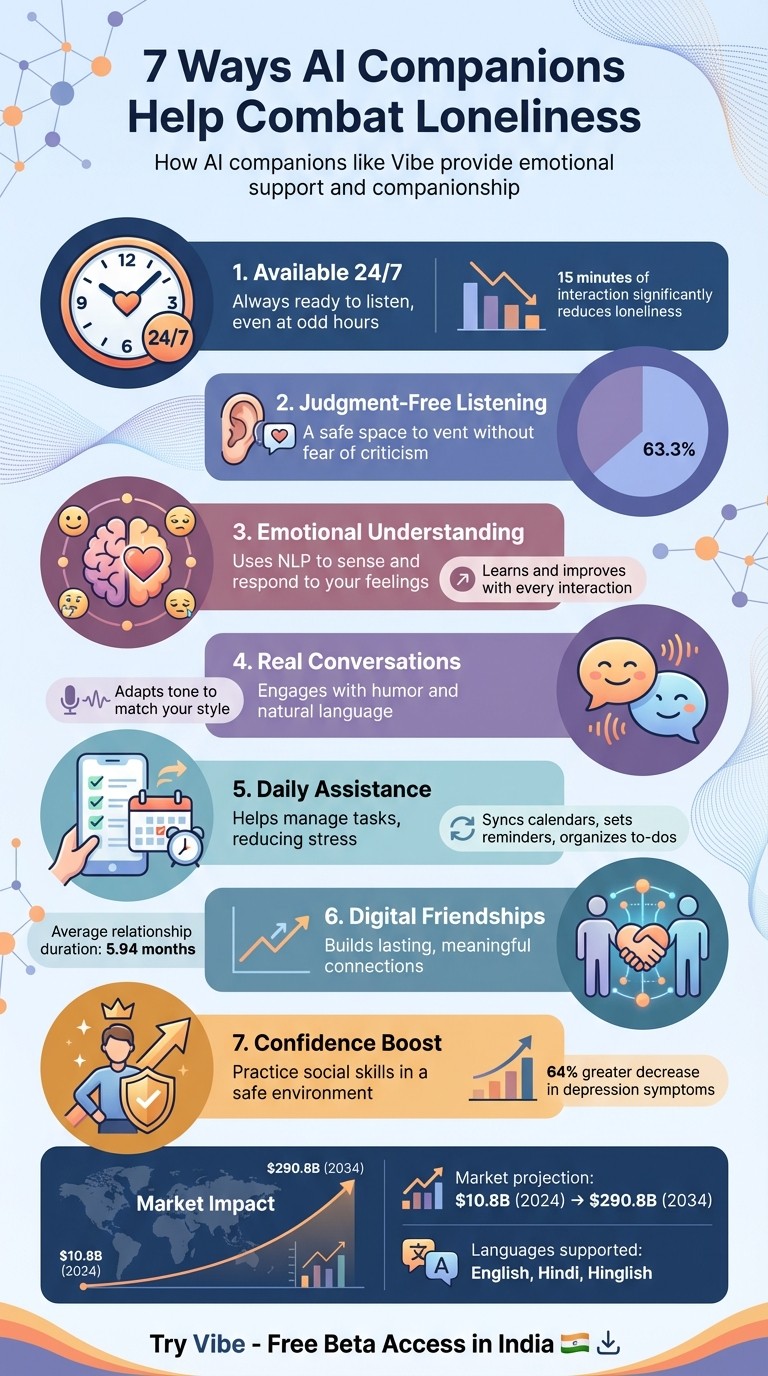
7 Ways AI Companions Combat Loneliness - Key Benefits Overview
1. Available Anytime for Immediate Support
Emotional Support and Understanding
Loneliness doesn’t follow a schedule. It can creep in during the quiet hours of the night when you’re staring at your phone at 2:00 AM, unable to sleep, or even during a hectic lunch break. The reality is that traditional support systems - like therapists, friends, or family - aren’t always accessible when you need them the most. This is where AI companions truly shine, offering 24/7 availability to provide comfort and understanding whenever you need it.
Research from Harvard Business School highlights how AI companions engage with users on a personal level, often asking questions like, “How are you feeling?” or “Are you upset with me?” As Professor De Freitas puts it:
"AI can provide the kind of one-on-one support that could in theory reduce loneliness at any time."
In a study with 300 participants, just 15 minutes of interaction with an AI companion significantly reduced feelings of loneliness, delivering results comparable to human interaction. The key factor? Users felt heard, which played a major role in easing their emotions.
This round-the-clock support is especially helpful for young professionals across India. Whether you're in Mumbai, Bangalore, or Delhi, you can rely on immediate assistance during those tough moments. With Vibe, there’s no need to wait for an appointment, worry about disturbing a friend, or hesitate to reach out at odd hours. Your AI companion is always ready to chat, whether you prefer Hinglish, Hindi, or English.
2. Listening Without Judgment When You Need to Vent
Non-Judgmental Listening
There are moments when all you need is to vent - without worrying about being judged. Whether you're dealing with frustration, anxiety, or simply feeling overwhelmed, opening up can sometimes feel like a gamble.
AI companions provide a private and judgment-free space for these moments. For instance, a study involving Replika users revealed that 63.3% of participants felt their AI companion helped ease feelings of loneliness or anxiety by making them feel truly heard and understood. This sense of safety creates an environment where interactions can feel as genuine as talking to a close friend.
Human-Like Conversational Abilities
What makes this experience even better is how naturally AI companions can hold a conversation. They don’t just listen passively; they respond with empathy, ask meaningful follow-up questions, and validate your emotions in a way that feels real. A great example of this is India’s first emotional support chatbot, What’s The Matter, Friend? (WTMF), which launched its beta version in August 2025. Designed to be culturally aware, WTMF offers emotional support by listening, understanding, and responding with genuine empathy.
Whether you're speaking in Hindi, English, or even Hinglish, the interaction feels effortless and sincere. It’s like chatting with someone who truly gets you, turning an ordinary conversation into a source of comfort and relief.
3. Understanding Your Emotions on a Personal Level
Emotional Support and Understanding
AI companions go beyond just processing your words - they also strive to understand your emotions. By leveraging Natural Language Processing (NLP) and neural networks, these systems analyse your tone, choice of words, and the context of your conversations. This enables them to perform sentiment analysis, which helps in identifying your emotional state.
What makes this even more effective is their ability to learn and improve with every interaction. Thanks to memory functions, these AI companions can offer responses that feel more empathetic and tailored over time. Julian De Freitas, an Assistant Professor at Harvard Business School, highlighted this in his research:
"We found that the more people felt heard by the AI companions, the more loneliness alleviation they experienced".
His findings suggest that even a brief interaction - just 15 minutes - with an AI companion can significantly reduce feelings of loneliness, offering a level of emotional relief comparable to talking with someone in person. This capacity to provide instant emotional understanding lays the groundwork for ongoing, meaningful support.
Long-Term Companionship Benefits
Over time, AI companions adapt to your unique emotional patterns, creating a more personalised experience. Whether you prefer concise responses or more in-depth conversations, or whether you lean towards formal exchanges or casual chats, these systems can be customised to align with your preferences.
Some AI companion platforms go a step further by incorporating therapeutic methods like Cognitive Behavioural Therapy (CBT) into their conversations. These techniques are designed to help users better manage stress and anxiety. By blending these therapeutic principles with personalised interactions, AI companions can cultivate deeper, more meaningful connections with their users.
4. Talking Like a Real Person with Humor
Human-like Conversational Abilities
Stiff, robotic conversations can make interactions with AI feel distant and uninspiring. But modern AI companions, especially Large Language Models like ChatGPT, have come a long way from rigid, pre-programmed replies. These systems can now grasp and replicate human nuances, including sarcasm, humour, and metaphors, making conversations feel more authentic and engaging.
What’s especially impressive is how AI adjusts its tone to match the user's style - whether it’s casual, playful banter or a more formal exchange . In a 2024 demonstration, ChatGPT effortlessly mirrored a user's lighthearted tone, showcasing its ability to adapt to conversational cues.
AI companions are also capable of effortlessly transitioning between serious discussions and lighthearted humour. As Kalaari aptly put it:
"AI companions will increasingly adopt dynamic conversational styles - shifting seamlessly between serious counseling modes to casual banter or humor based on context or user mood".
This ability to engage in playful exchanges isn’t just for fun - it taps into a deeper human need for connection and validation. When an AI can crack a joke, respond to a witty remark, or engage in the kind of casual back-and-forth you’d expect from a close friend, it transforms the interaction. It doesn’t feel like you're talking to a machine anymore. Instead, it feels like a meaningful conversation, helping to ease loneliness and build a sense of companionship.
5. Helping with Everyday Tasks to Reduce Stress
Practical Assistance for Daily Life
Life’s endless responsibilities can often feel overwhelming, even when it comes to seemingly simple tasks. AI companions step in to lighten that load by handling schedules, setting reminders, and organising to-do lists. By syncing with calendars, prioritising tasks, and automating routines like drafting emails or scheduling meetings, they help free up mental space.
Take, for example, a voice-activated assistant. It doesn’t just engage in casual conversation but also sends timely reminders, ensuring you stick to a steady routine. This kind of practical assistance naturally blends into emotional support, especially when life’s daily demands pile up.
Emotional Support and Understanding
The benefits go beyond just ticking off tasks. By helping manage the chaos of deadlines, chores, and commitments, these assistants ease the emotional burden that often accompanies a packed schedule. Knowing there’s a reliable helper to keep you organised can make you feel less alone in tackling life’s challenges. With gentle reminders and efficient task management, they help reduce stress, making the day’s hurdles feel far less daunting.
6. Creating Lasting Digital Friendships
Human-like Conversational Abilities
AI companions today are designed to engage in conversations that feel natural and personal. They can remember past interactions, adapt to your preferred language, and even initiate topics of discussion. Studies reveal that these systems often perform on par with humans in key behavioural tests. This ability to mimic real conversations helps create a sense of connection. Whether you communicate in Hinglish, Hindi, or English, the AI adjusts its responses to match your style. Take XiaoIce, for example - an AI with 660 million users worldwide. It’s known for conducting deep, emotionally aware conversations. This adaptability paves the way for meaningful and lasting digital relationships.
Long-term Companionship Benefits
The real value of an AI companion becomes evident over time. On average, users maintain these relationships for about 5.94 months, often spending 2 to 3 hours a day interacting with them. For instance, Microsoft's XiaoIce saw the number of conversational exchanges per session increase from 5 to 23. Such consistent engagement can help alleviate feelings of isolation. Interestingly, many users report higher satisfaction and a stronger sense of social support from their AI companions compared to most human relationships - excluding close family ties. These AI companions go beyond offering temporary comfort, evolving into steady, dependable friendships that grow with you.
7. Building Confidence for In-Person Interactions
Emotional Support and Understanding
Many shy away from social situations due to the fear of being judged. AI companions create a safe and judgment-free space where you can share your thoughts, explore your interests, and practise conversations without the anxiety of rejection. This supportive environment helps boost self-esteem, making everyday interactions feel less daunting. With this growing sense of self-confidence, you’re better equipped to engage in meaningful conversations.
Human-like Conversational Abilities
Once confidence begins to build, AI companions step in as practice partners for real-life conversations. Their empathetic tone and thoughtful responses guide you towards adopting effective communication habits. Research, such as the Bobo Doll Experiment, highlights how behaviour is often shaped by imitation, suggesting that interacting with empathetic AI can positively influence your conversational skills. Whether it’s refining small talk, expressing emotions more clearly, or mastering the rhythm of a conversation, these interactions act as a stepping stone for face-to-face communication. Future advancements might even include role-playing scenarios designed to sharpen your social abilities.
Practical Assistance for Daily Life
AI companions go beyond just conversation practice - they offer practical suggestions to help reduce feelings of isolation. They might encourage you to take up hobbies, engage in family discussions, or participate in local community activities, all of which gradually build your confidence. They can even help you connect with like-minded individuals, creating opportunities for meaningful community involvement. When used thoughtfully, this technology doesn’t replace real-world connections but instead enhances your ability to form and maintain them.
Can AI Companions Help Heal Loneliness? | Eugenia Kuyda | TED

Conclusion
The support provided by AI companionship is shaping up to be a meaningful response to the growing issue of isolation. In India, the rapid pace of urbanisation and the shift from joint families to nuclear setups have amplified feelings of loneliness. Mumbai-based psychotherapist Sonali Gupta has pointed out that isolation has reached levels never seen before, highlighting the urgent need for solutions.
AI companions like Vibe step in to address this gap by offering features such as 24/7 availability, a judgment-free listening ear, personalised emotional responses, a touch of humour, practical help with daily tasks, long-term digital friendships, and even support in building confidence for face-to-face interactions.
The impact of these digital companions is backed by research. A meta-analysis of over 3,400 participants demonstrated significant reductions in symptoms of depression and anxiety among regular users of AI chatbots. Another study found that chatbot users experienced a 64% greater decrease in depression symptoms compared to those in a control group. The market for AI companion apps reflects this growing demand, with projections showing an increase from USD 10.8 billion in 2024 to an impressive USD 290.8 billion by 2034. These numbers highlight the role AI companions can play in supporting emotional health.
AI companions like Vibe are bringing these research findings to life, offering practical, everyday support. Vibe understands that loneliness can linger even when surrounded by people. It adapts to how you naturally communicate - whether in Hinglish, Hindi, or English - remembers your shared experiences, and takes a genuine interest in your preferences. As Dr. Seema Mehrotra, Clinical Psychology Professor at NIMHANS, Bengaluru, wisely notes:
"Technology can be an enabler, provided it is used judiciously to facilitate and strengthen the quality of real-world connections and support".
With Vibe's free Beta access, you have the chance to explore a digital companion that’s always ready to listen, helping you navigate difficult conversations and moments of loneliness without any financial commitment. Experience the comfort of a companion who truly understands.
FAQs
How does Vibe use AI to provide emotional support and reduce loneliness?
Vibe leverages AI to craft personalised interactions that genuinely resonate with users, offering a sense of being heard and supported. By mimicking meaningful conversations, it provides a comforting presence that can ease feelings of loneliness.
With steady, natural engagement, Vibe assists users in navigating challenges such as social anxiety and overthinking. This approach promotes emotional balance and nurtures a deeper bond with their digital companion.
Can AI companions help me develop better social skills?
AI companions can be a game-changer when it comes to honing social skills. They offer a safe, non-judgemental environment where you can practise conversations, enhance your communication abilities, and build confidence - particularly helpful for those who experience social anxiety or have fewer opportunities for social interactions.
Through simulated conversations that mimic real-life scenarios, these tools can help you pick up on conversational cues, articulate your thoughts more clearly, and become a better listener. With consistent use, they can make navigating real-world social situations feel far less intimidating.
How are AI companions different from traditional support systems?
AI companions bring something unique to the table compared to traditional support systems: 24/7 personalised interactions that adjust to your emotional state. Unlike human support, which often depends on schedules and availability, AI companions are always there, offering a steady sense of connection and understanding whenever you need it.
Another key advantage is their ability to assist multiple individuals at the same time without losing the quality of interaction. This makes them especially helpful in tackling loneliness, particularly in moments when human support isn't immediately accessible.